History as a Literary Art an Appeal to Young Historians
/https://tf-cmsv2-smithsonianmag-media.s3.amazonaws.com/filer/Presence-Battle-Pacific-ships-631.jpg)
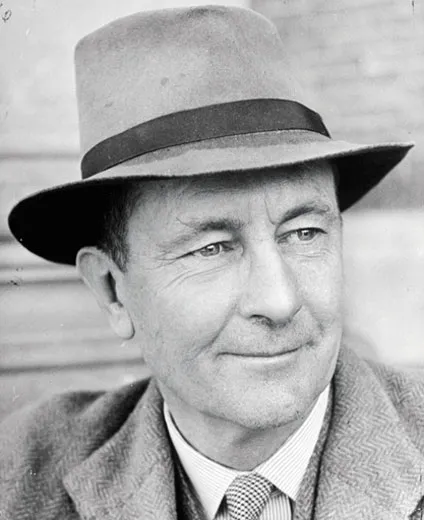
On March 23, 1942, the historian Samuel Eliot Morison wrote to his friend President Franklin D. Roosevelt to offer himself as a "sea-going historiographer" to relate the activities of the U.Due south. Navy in Earth War Ii. "In order to exercise it the right way," he told Roosevelt, "I must have a living, intimate connection with the Navy flagrante bello. An armchair history job after peace is concluded won't do." Before April was out, Morison was coming together with Navy officials to have a commission as a lieutenant commander and discuss the logistics of his world-spanning assignment.
That July, he boarded a destroyer and pressed into the cold swells of the Atlantic to witness the war against Germany'due south U-boats. In ten other ships, over 3 years, Morison clustered the eyewitness experience that buoyed his 15-book History of The states Naval Operations in World War 2. The series, published between 1947 and 1962, was not only a comprehensive report on the Navy'due south project of power over 2 oceans, but a classic of historical literature that stands as the definitive treatment of its subject. And now that the Naval Plant Press is reissuing the serial, with Volumes 7 through 9 due this jump, Morison'south masterwork is worth considering as a lesson in how history can have both blue-ribbon scholarship and popular appeal—and why works of such scale are well-nigh never published anymore.
Morison (1887–1976) was 1 of the pre-eminent historians of his generation—among his many honors were 2 Bancroft Prizes and 2 Pulitzers—but he worried about who read history and why. "When John Citizen feels the urge to read history, he goes to the novels of Kenneth Roberts or Margaret Mitchell, not to the histories of Professor this or Doc that," he lamented in his 1946 pamphlet, "History as a Literary Art: An Appeal to Young Historians." Every bit Morison saw it, academic historians had only themselves to blame: "They have forgotten that there is an art of writing history." For Morison, fine writing required deep living.
He grew upwards on Boston's swank Beacon Loma, in a red-brick firm whose mantelpiece had come from Daniel Webster's living room. In 1904, at the age of 17, he crossed the Charles River to attend Harvard, which would be the fulcrum of his academic life until he retired in 1955. But he did his most important work far from Cambridge.
To enquiry a biography of Christopher Columbus, Morison spent five months aboard a 3-masted sailing send, retracing the explorer's routes ten,000 miles across the Atlantic and around the Caribbean area. The resulting volume, Admiral of the Ocean Bounding main: A Life of Christopher Columbus (1942), made Morison's proper noun every bit a scholar who was not content to dwell in the archives. Information technology also gave him entree. "That Columbus volume...brought me a welcome from sailors everywhere," he once said. "It did me more than good than the [naval] committee. Columbus was my passport."
When Morison visited the Navy Department in 1942 to hash out his intention to write well-nigh its operations during the state of war, Adm. Ernest J. King, the commander in chief of the U.S. fleet, "looked bleak, wintry," Morison recalled in 1960. Famously obsessed with secrecy, Rex viewed anyone who presumed to write about his dearest Navy through gimlet eyes. Then, Morison recalled, came a flash of recognition: Rex said, "Oh, you're that boyfriend." Morison was on his way, with access to all the Navy'due south personnel, records, ships and facilities. There were no restrictions on what he could write. The Navy would sign the contract for the serial with Little, Brownish, but the history would be Morison's, not an "official" i.
Thus Morison plunged into the war, crossing the Atlantic aboard the destroyer USS Buck. He would lament subsequently that a "whole generation has passed without producing any really corking works on American history. Plenty of skillful books, valuable books, and new interpretations and explorations of the past; but none with fire in the eye, none to make a young man want to fight for his state in war or live to make information technology a better land in peace." That was the sort of work he had set out to produce.
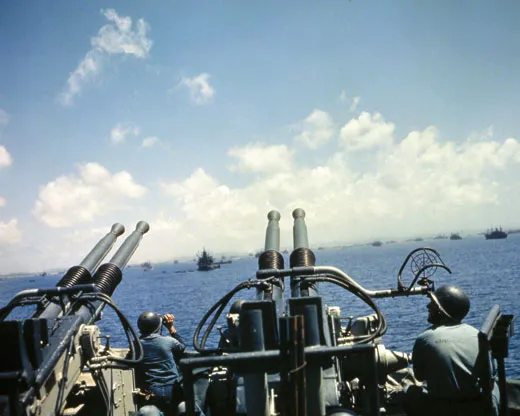
He congenital his narratives around brightly rendered visuals and used the present tense to describe actions he witnessed firsthand, such equally the Battle of Kolombangara in July 1943. "A gallant sight at that hour," he wrote of the U.S. gainsay squadron's steaming toward the confrontation in the Solomon Islands, "the cruisers and so proud and handsome with their curling bow waves and frothy wakes, the destroyers thrusting and turning, now golden with the sun, at present nighttime shadows against the sea; and this is a gorgeous afternoon, with bright cumulus clouds under a thin layer of cirrus and Ironbottom Sound blue every bit the Gulf of Maine."
Of course, serious histories are made of more than than fire in the centre and muscle in the prose. Morison, wrote the Yale historian Edmund Due south. Morgan, had the "backbone to simplify." All historians practise so, Morgan observed, but not always to good effect. "To simplify where yous know little is piece of cake," Morgan wrote in a 1964 essay about Morison in the New York Times. "To simplify where you know a cracking bargain requires gifts of a different order: unusual penetration of listen and, above all, sheer nerve."
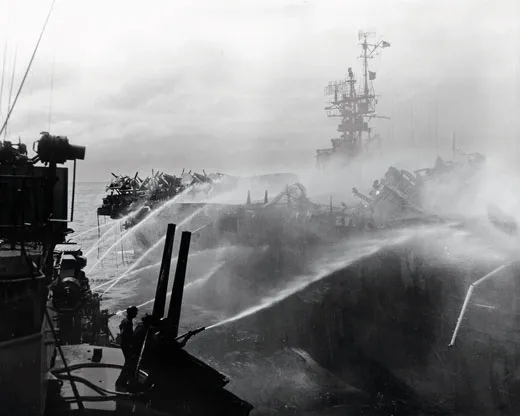
Morison's nerve was evident in his addiction of holding the reader tightly in the moment, then soaring away to view events from great heights. He could evoke the immediate terror of battle, then pivot toward a context reaching to antiquity. A bottom author might have noted that the Battle of Leyte Gulf rendered traditional lines of big-gunned dreadnoughts obsolete. Morison wrote: "When Mississippi discharged her twelve fourteen-inch guns at Yamashiro at a range of 19,790 yards, at 0408 October 25, 1944, she was not only giving that battleship the insurrection de grâce, but firing a funeral salute to a finished era of naval warfare. One tin imagine the ghosts of all cracking admirals from Raleigh to Jellicoe standing at attention as [the] Battle Line went into oblivion, along with the Greek phalanx, the Castilian wall of pikemen, the English longbow and the row-galley tactics of Salamis and Lepanto."
Morison also had the nerve to employ "we" or "you," and to speak on behalf of the nation—sometimes in the same sentence. ("However y'all expect at it, the Battle for Leyte Gulf should be an imperishable part of our national heritage.") Embedded reporters today guard confronting such a stance for fearfulness they will give the advent of bias, but Morison identified with his subjects and sources. "Historians in years to come may shoot this book full of holes," he wrote in the preface to Volume 1, "but they can never recapture the feeling of drastic urgency in our planning and preparations, of the excitement of battle, of exultation over a difficult performance successfully concluded, of sorrow for shipmates who did non live to enjoy the victory."
Historians did take their shots. Some critics saw his treatment of the Japanese as narrow and xenophobic. Co-ordinate to H. P. Willmott, who wrote the introduction to Volume 3, Morison indeed viewed the Japanese as "little more than a savage and unprincipled enemy." (Similarly, Morison and Henry Steele Commager faced criticism for crudely stereotyping African- Americans in their textbook Growth of the American Democracy.) Morison also avoided the controversy of the initial Pearl Harbor enquiry, infamous for scapegoating commanders in Hawaii, Adm. Husband Due east. Kimmel and Lt. Gen.Walter Short. And he reflected a bias in the argument over prewar naval policy past commissioning the sometime Navy senior historian Dudley Knox to write the introduction to the series; Knox had been sharply critical of the Harding administration's consent to naval arms limitation treaties. In its new edition, the Naval Institute has replaced his slice with an essay by Naval Academy historian Robert W. Love Jr., who calls Knox'due south introduction a "pejorative, factually inaccurate distortion of American foreign and naval policy."
Ultimately none of these complaints would dislodge the serial from its pedestal. Edmund Morgan chosen information technology "no mere risk story, no mere working up of salty flavor to make tiresome facts more palatable. It is, instead, what all great history and indeed all great literature must be, a commentary on human." "Commentary" is an apt discussion, for Morison's authority came from his willingness to assert his judgment, which in turn earned him a connexion with his readers. Richard B. Frank, an writer and historian of the Pacific state of war, sees no diminution in the series' value over fourth dimension. "As long as Earth War 2 at sea is remembered," he says, "Morison will remain the touchstone."
Today, the odds seem remote that any publisher would presume the risk of commissioning a 15-volume series by a unmarried author. "Publishers don't like to commit to multiple volumes because they don't think readers will commit to reading them," says H. W. Brands, a historian at the University of Texas. "The nigh successful multivolumes have occurred by accident, so to speak, and are typically biographical." (Arthur Schlesinger Jr., for instance, got "carried away," Brands says, when he produced iii volumes virtually FDR.) At the same fourth dimension, market forces are non unkind to historical works: good narrative-driven history is published every season and has never been more popular; authors such as David McCullough and Doris Kearns Goodwin are fixtures on the best-seller lists. So the country of the market only partially explains why Morison'due south series remains singular. As a author of naval history myself, and as a writers' agent, I see some other, and perhaps more powerful, cistron at work: an optimal convergence between writer and field of study.
As surely every bit Morison had intellectual depth and literary talent, he also had luck. When he sailed on the Buck he was 55 years old—mature enough to exist confident in his judgment just young enough to undertake so monumental an effort (unlike, say, William Manchester, whose failing wellness before his 2004 death at age 82 doomed his promise to complete a trilogy on Winston Churchill). His circumstances, with his talents and his admission, allowed him to take total control of his subject.
And what a subject. Equally Hanson Due west. Baldwin, the former New York Times war correspondent and editor once put information technology, "World War II is i with man's Homeric yesterdays—an epoch, like the Trojan wars, to exist read about, studied, imagined." With its vast geography and far-flung campaigns, information technology all but demanded the handling Morison was allowed to give information technology. In ballsy scale, moral clarity and personal relevance to Americans, it may surpass even the American Revolution and the Civil War. Ultimately, that is why Morison'south masterwork seems destined to stand lone.
For more 2 generations since, our wars have been less conclusive and more than divisive. They tend to lack the large-scale set-piece dramas that characterized wars between similarly armed nations. They no longer conclude with treaties and victory parades. Simply the American experience in Globe War Two however inspires readers. Several authoritative writers—including Richard Frank, Rick Atkinson and Ian West. Cost—are at work on trilogies about that war. But but Morison volition ever be, in Baldwin'due south words, "a modernistic Thucydides." Like the bully Greek historian who chronicled the Peloponnesian War from living witness, Morison explored the whole turning world at war and fabricated it his ain.
James D. Hornfischer is the writer of a new Earth War Two history, Neptune'due south Inferno: The U.S. Navy at Guadalcanal.
Source: https://www.smithsonianmag.com/history/revisiting-samuel-eliot-morisons-landmark-history-63715/
0 Response to "History as a Literary Art an Appeal to Young Historians"
Postar um comentário